Sun-Related vs Hormone-Related Melasma: What Is the Difference?


Sun-related and hormone-related melasma can involve different triggers, but appearance alone cannot confirm the cause. Ultraviolet and visible light, hormonal changes, family history and individual skin factors may influence melasma. Therefore, a doctor’s assessment is more useful than choosing a laser based only on its name.
Contents
What is melasma?
Melasma is a pattern of darker patches that commonly appears on the face, including the cheeks, forehead, nose or area above the lips. In addition, several factors may contribute, and different causes can produce patches that look the same.
What can trigger sun-related melasma?
Ultraviolet and visible light can stimulate pigment production and make facial pigmentation more noticeable in some people. In addition, repeated exposure and insufficient protection may contribute to darker-looking patches.
Sun exposure does not automatically make a dark patch sun-related melasma. Freckles, post-inflammatory hyperpigmentation and other pigment conditions may look similar, so history and examination matter.
What is hormone-related melasma?
Hormonal changes may be associated with melasma in some people, including pregnancy or certain medicines and contraceptive methods. However, this does not mean that everyone with melasma has a hormone disorder.
Tell your doctor about pregnancy, contraception, medicines and relevant medical history when discussing a change in pigmentation.
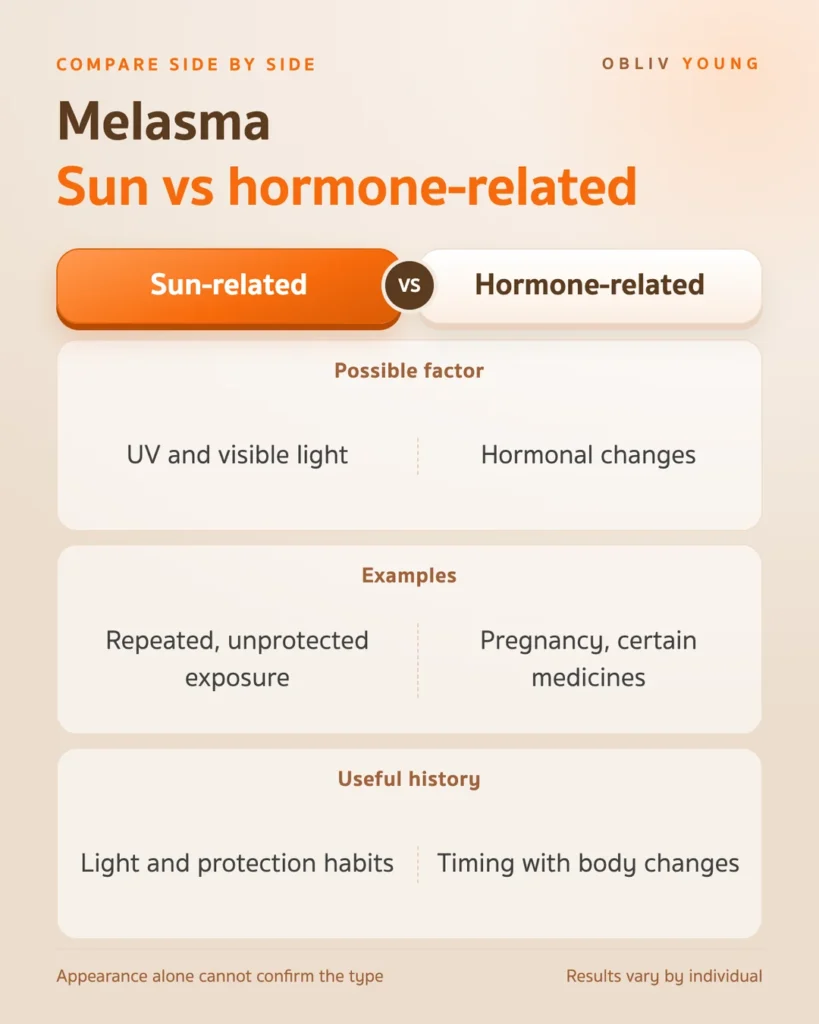
Sun vs hormone-related melasma
| Point | Sun-related factors | Hormone-related factors |
|---|---|---|
| Possible factor | Ultraviolet and visible light | Hormonal changes together with other factors |
| Useful history | Exposure to light and skin-protection habits | Timing with body changes, medicines or contraception |
| Self-assessment | Appearance alone cannot confirm the type or cause | |
| Care planning | Depends on assessment, triggers, skin type and individual risk | |
Melasma vs freckles
Melasma and freckles can look similar, while their pattern, size, distribution and contributing factors may differ. Moreover, people can also confuse them with acne marks and irritation-related pigmentation.
For an overview of pigmentation, acne marks and uneven skin concerns, see Skin Clarity.
Where does laser treatment fit?
A clinician may consider laser treatment in selected cases, but suitability depends on the type of pigmentation, skin tone, triggers, previous care and individual risk. Also, no single device is right for everyone.
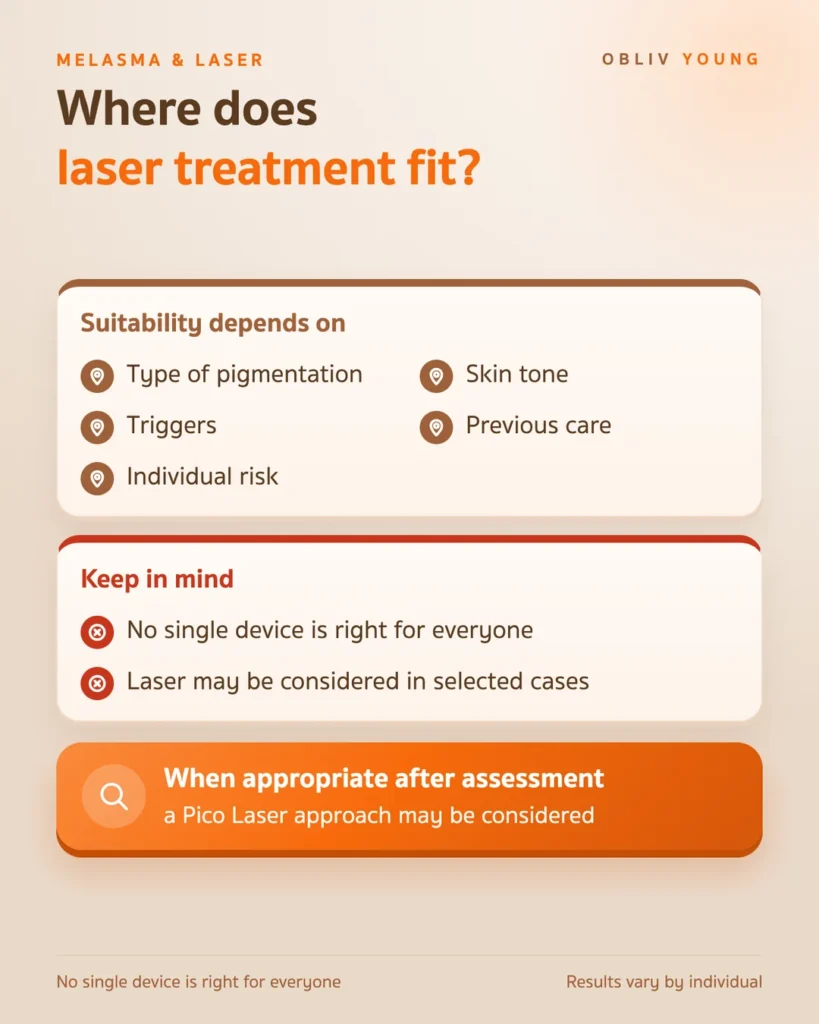
After assessment, a clinician may consider a Pico Laser approach when appropriate. Read more about the service at Pico Laser.
When should you seek an assessment?
- The pigmentation is becoming darker or changing over time.
- You are unsure whether it is melasma, freckles or an acne mark.
- It became more noticeable after a medication, contraception or pregnancy change.
- Self-care has caused irritation or you are unsure which option to choose.
However, an assessment does not mean that you must have a procedure. It can help clarify possible contributing factors and an appropriate starting point. Contact Obliv Young to ask questions or arrange an assessment.
Frequently asked questions
Can you tell sun-related and hormone-related melasma apart by appearance?
Appearance may provide clues but cannot confirm the cause. History and assessment are important.
Does hormone-related melasma always require hormone testing?
Not everyone needs testing. The decision depends on history, symptoms and a doctor’s assessment.
Can melasma be treated with laser?
A clinician may consider laser in selected cases, but treatment planning and response vary by person.
Can melasma become darker again?
Melasma can change with light exposure, hormonal factors and individual triggers. You may need ongoing care.
This article is general information, not a diagnosis. Treatment planning should be based on an assessment by a qualified doctor.
This article was medically reviewed by
Mr. Park Young Jin
Education
Graduated with a Doctor of Medicine degree from Inha University College of Medicine, and completed an executive program at Seoul National University. Gained experience as a Public Doctor within the government sector before advancing into Aesthetic Medicine with leading Korean clinic groups, including Forever Plastic Surgery, Ppeum Clinic, and Y&I Clinic, serving as a physician and Senior Doctor
Specializes in
Specializes in Aesthetic Medicine, Facial Contouring, and Facelifting Techniques, serving as President of the Obliv Clinic Network (Incheon, Bangkok, Dubai). Also active in the academic community as Academy Director of the Korean Aesthetic Surgery & Laser Society and Senior Director of the Korean Academy of Facelifting and Contouring , as well as a Global KOL and Key Doctor for leading brands including Wontech, MERZ, Jetema, Amalian, and Gouri, covering Filler, Energy-Based Devices, and Skin Rejuvenation technologies internationally. Source: Aestheticsa