How to Treat Acne Scars: Understand the Type Before Choosing an Option



Short answer: Depressed acne scars form when inflammation damages the skin and the healing process does not restore enough supporting collagen. Treatment depends on scar type, depth, number, skin tone, active acne, previous procedures, and the person’s goals. Rolling, boxcar, and ice-pick scars can require different approaches, and some people need a staged or combined plan. No single treatment is suitable for every scar, and no article can diagnose scar type from a photograph alone.
Key Takeaways
- First distinguish a depressed scar from a flat red or dark post-acne mark.
- Rolling, boxcar, and ice-pick scars differ in shape and depth.
- A clinician should assess active acne before planning scar procedures.
- The aim is usually to make scars less noticeable, not to promise perfectly scar-free skin.
อ่านหัวข้อที่สนใจ
- What is an acne scar, and how is it different from a mark?
- What are the main scar types?
- What does assessment consider?
- What treatment categories may be discussed?
- Why might a combined approach be needed?
- When should you seek assessment?
- FAQ
What is an acne scar, and how is it different from an acne mark?
An acne scar is a lasting change in skin texture after a breakout heals. A depressed scar creates an indentation, while a raised scar sits above the surrounding skin. A flat red, pink, brown, or grey area may instead be a post-inflammatory mark, not a true scar.
That distinction changes the treatment conversation. For flat colour changes, read the existing acne-marks guide. This article intentionally focuses on scar morphology and treatment decisions rather than becoming a second marks or laser page.
What are rolling, boxcar, and ice-pick scars?
Rolling scars are often wider and shallow, giving the surface a wavy appearance under certain lighting. Fibrous tethering beneath the skin affects some, so the underlying attachment may matter as much as the surface texture.
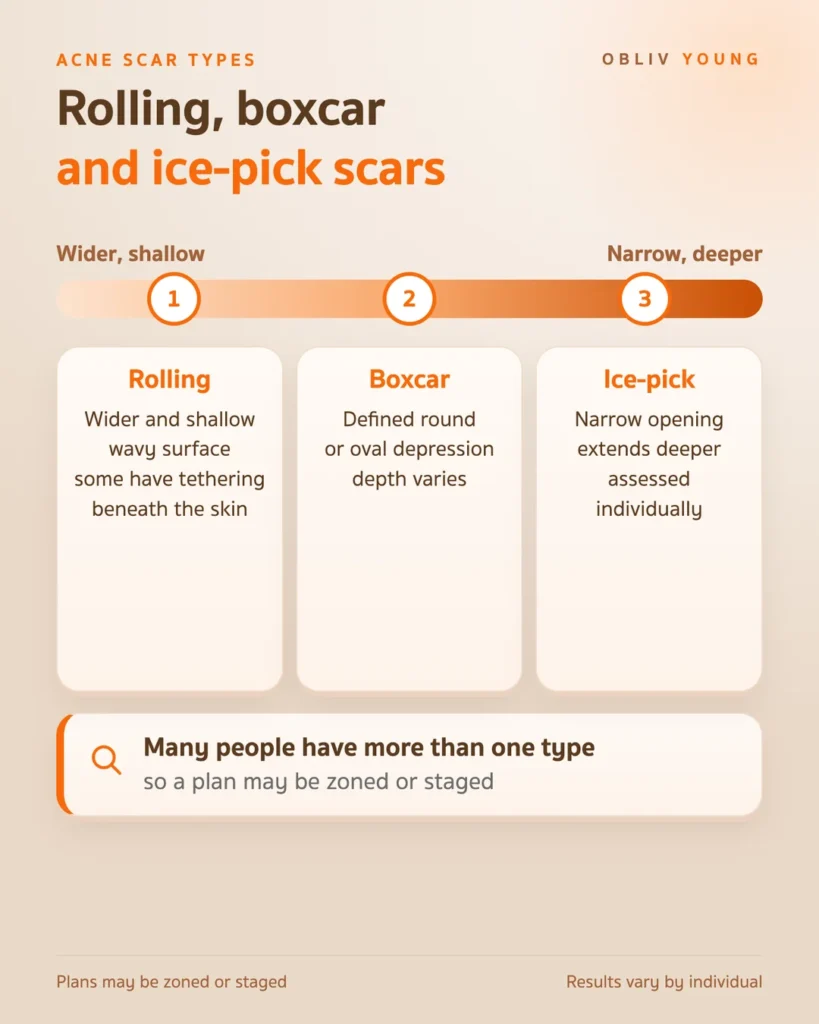
Boxcar scars have a more defined, round or oval depression. Their depth varies, and a shallow boxcar scar is not the same treatment problem as a deeper one.
Ice-pick scars have a narrow opening but extend deeper into the skin. Smoothing the surface alone may not address the full structure, so a clinician should assess them individually.
Many people have more than one scar type. Clinicians may therefore zone or stage a treatment plan instead of basing it on one device name.
How do clinicians decide how to treat acne scars?
- Confirm whether the concern is a true scar rather than a red or dark post-acne mark.
- Assess the scar pattern, such as rolling, boxcar, or ice-pick scars, because each can respond differently.
- Review active acne, previous treatments, and how long the skin has been stable.
- Discuss skin condition and suitability with a clinician before choosing a procedure by name alone.
Assessment usually considers the scar type, depth, number, skin tone, elasticity, history of raised scarring, active acne, past procedures, expected downtime, and the person’s goals. Budget and tolerance for recovery also matter, but a price-first decision can miss important safety factors.
If active acne or infection is present, the clinician may recommend controlling that issue before or alongside scar treatment. Treating an inflamed surface is not appropriate for every person or every procedure.
What treatment categories may be discussed?
A gentle routine, sun protection, and avoiding picking can reduce irritation and help prevent new marks, but do not expect a cream to instantly fill a deep indentation. Be cautious with “acne scar cream” claims that promise a procedure-like change.
A clinician may consider laser or energy-based resurfacing for selected texture concerns. Our Pico Laser acne-scar article covers Pico-specific intent; it is linked here for readers comparing that modality, not as proof that Pico is right for every scar.
Clinicians may discuss microneedling or radiofrequency-based approaches in some plans to support collagen remodelling. Settings, suitability, skin response, and post-treatment pigment risk require clinical judgement.
Clinicians use the term subcision for certain rolling scars affected by tethering. Clinicians discuss TCA CROSS as a focal chemical approach for selected ice-pick scars. This article includes them only as comparison concepts, not as self-treatment instructions or confirmation that Obliv Young offers either procedure.
A clinician may consider a filler for selected depressed scars to add support or volume, but this is an injectable decision with individual risks and limitations. It should follow an examination and a clear discussion with a doctor rather than a general assumption that filler is the answer to every pit.
Why might more than one approach be needed?
A rolling scar may combine surface irregularity with tethering, while boxcar and ice-pick scars have different edges and depths. Addressing more than one feature can lead to a staged plan, but the number and order of sessions must come from assessment. Another person’s before-and-after story does not predict an individual result.
Scar treatment may make texture less noticeable and skin more even, but it cannot guarantee complete removal. Redness, irritation, pigment change, prolonged recovery, or raised scarring can occur in some people. Ask what is realistic for your skin before proceeding.
When should you seek professional assessment?
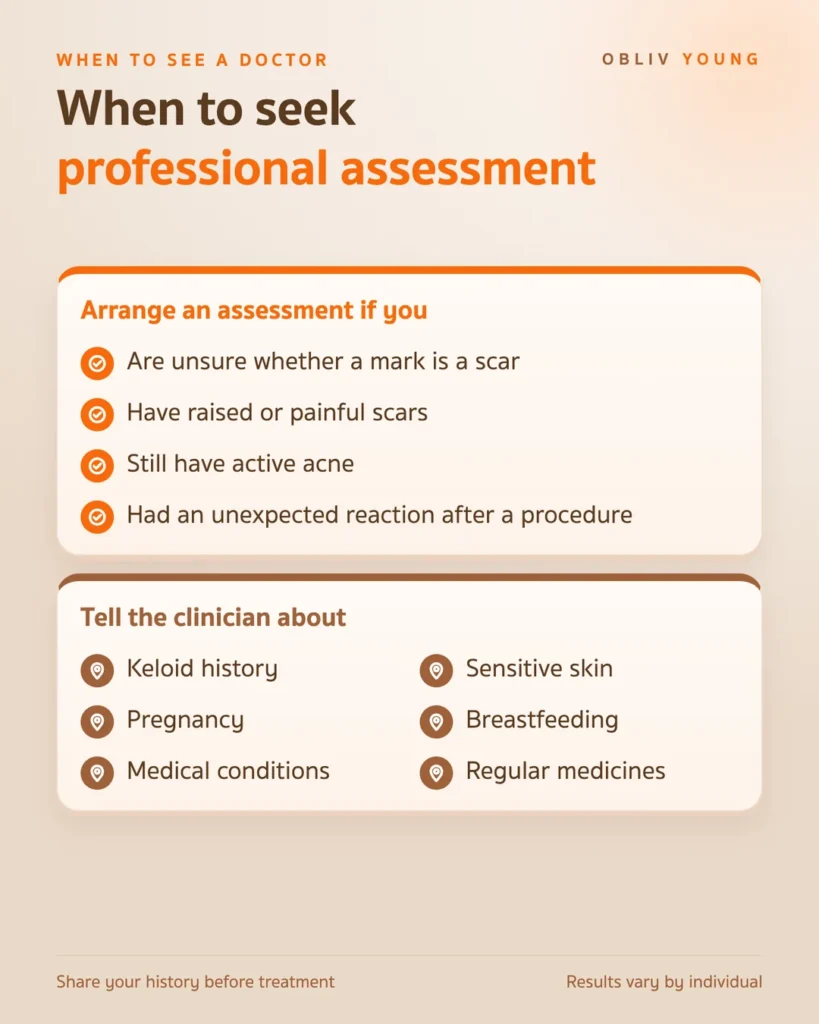
Arrange an assessment if you are unsure whether a mark is a scar, have raised or painful scars, still have active acne, or have had an unexpected reaction after a procedure. Tell the clinician about a history of keloids or hypertrophic scars, sensitive skin, pregnancy or breastfeeding, medical conditions, and regular medicines.
For a specific named modality, see the existing Sylfirm pores and scars article. It remains the owner for Sylfirm-led intent, while this guide remains the general scar-decision owner.
FAQ
Can acne scars disappear on their own?
Some scars may soften or become less noticeable over time, but depressed scars rarely disappear completely without treatment. A clinician can help distinguish them from flat marks and discuss realistic options.
Can acne-scar cream treat deep pits?
A product may support overall skin care or make mild unevenness look less noticeable, but do not expect it to fill a deep scar immediately. Introduce active products carefully and avoid combining several irritating products to “speed up” results.
What is the difference between rolling, boxcar, and ice-pick scars?
Rolling scars are usually wider and shallow, boxcar scars have more defined depressions, and ice-pick scars are narrow but deep. Mixed scar types are common, so an examination is more useful than choosing by label alone.
What are subcision and TCA CROSS?
These names refer to approaches that clinicians discuss for selected scar patterns. Subcision addresses tethering beneath certain scars, while TCA CROSS is a focal chemical approach for some ice-pick scars. This article provides context only; it is not a DIY instruction or a confirmation of clinic availability.
Should active acne be treated before acne scars?
If acne is active or infection is suspected, a clinician should decide whether to address it first or alongside scar planning. A scar procedure may not be suitable for every inflamed skin condition.
If you would like to understand your main skin concern, you can contact Obliv Young to ask questions and arrange an assessment.

This article was medically reviewed by
Mr. Park Young Jin
Education
Graduated with a Doctor of Medicine degree from Inha University College of Medicine, and completed an executive program at Seoul National University. Gained experience as a Public Doctor within the government sector before advancing into Aesthetic Medicine with leading Korean clinic groups, including Forever Plastic Surgery, Ppeum Clinic, and Y&I Clinic, serving as a physician and Senior Doctor
Specializes in
Specializes in Aesthetic Medicine, Facial Contouring, and Facelifting Techniques, serving as President of the Obliv Clinic Network (Incheon, Bangkok, Dubai). Also active in the academic community as Academy Director of the Korean Aesthetic Surgery & Laser Society and Senior Director of the Korean Academy of Facelifting and Contouring , as well as a Global KOL and Key Doctor for leading brands including Wontech, MERZ, Jetema, Amalian, and Gouri, covering Filler, Energy-Based Devices, and Skin Rejuvenation technologies internationally. Source: Aestheticsa