Does Pico Laser Treat Acne Scars? What to Know Before You Book

Article by Obliv Young Editorial · medically reviewed by the Obliv Young Clinic team · last updated August 2026
This content is for educational purposes only and is not a medical diagnosis. Please consult a doctor for an individual assessment. Timelines and session counts mentioned here are commonly observed averages, not a guarantee for every patient.
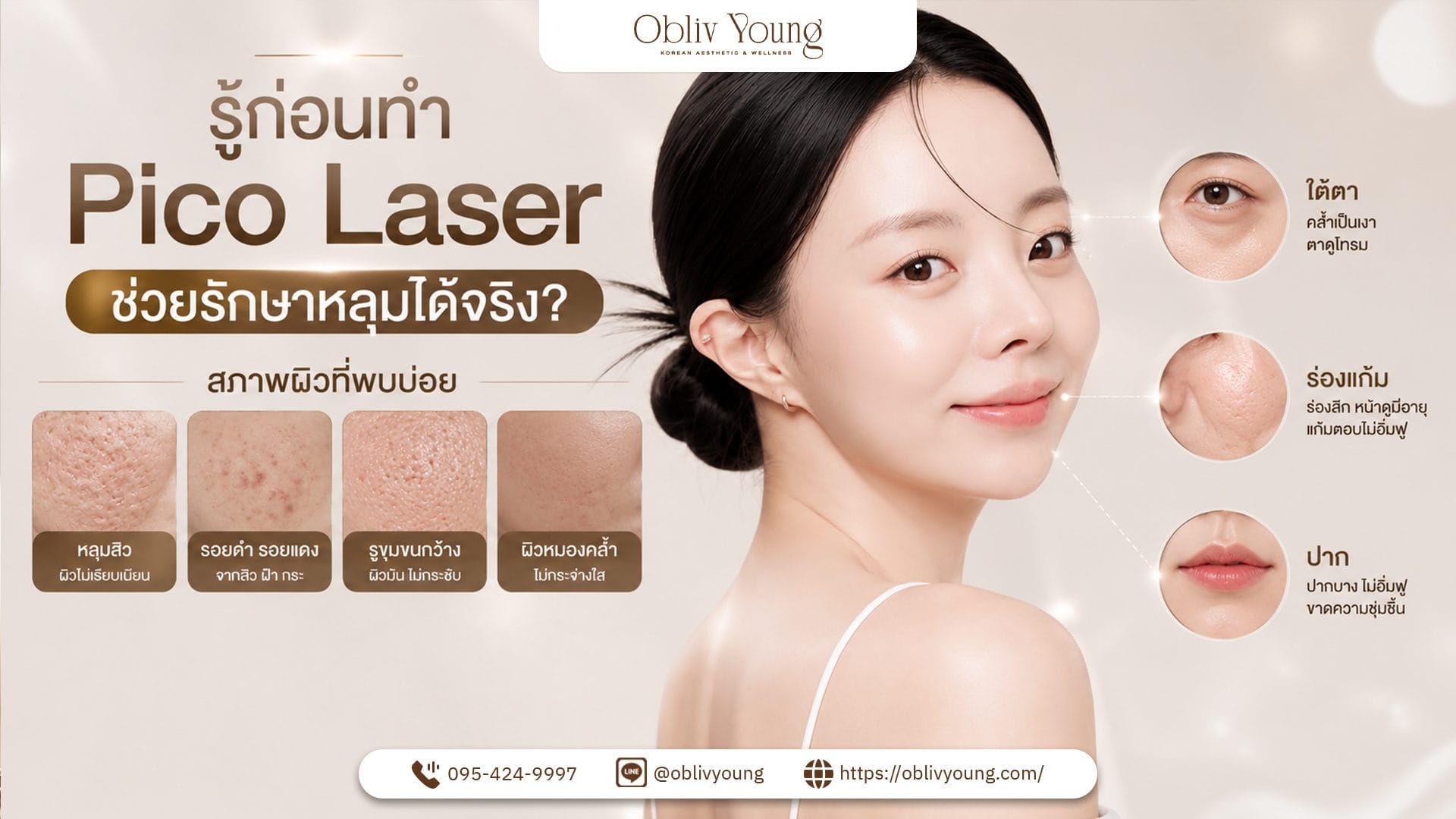
A clinician may consider Pico laser for some acne-scar concerns, but it is not a universal treatment for every scar type. The useful first step is to identify whether the main concern is a dark mark, redness, uneven texture, rolling scar, boxcar scar, or ice-pick scar. A doctor can then assess whether Pico laser alone is appropriate or whether another approach should be discussed.
This guide walks through what causes acne scars, how pico laser works, what it can and can’t fix on its own, and what actually drives the cost — so you’re making a decision based on real information, not a promotional headline.
Which acne scars may respond to Pico laser?
Pico laser is more straightforward to discuss when the concern is an acne mark, uneven tone or selected surface-texture concerns. Depressed scars such as rolling, boxcar and ice-pick scars have different structures, so do not assume the same treatment works in the same way for all three.
Ask about the scar type, the treatment goal, expected downtime and alternatives before booking. Session numbers and results vary by scar depth, skin condition and the treatment plan.
Quick summary
- Acne scars generally fall into three types — ice pick, boxcar, and rolling — and they don’t respond to laser the same way
- Pico laser tends to work well on shallow-to-moderate scars (boxcar/rolling), less so on deep ice pick scars alone
- It’s a course of treatment, not a single session
- Pricing depends on treatment area, scar depth, and the number of sessions your doctor plans — there’s no fixed number that applies to everyone
- A doctor should assess your scars in person before setting any treatment plan, especially for deeper scarring
What causes acne scars, and how many types are there?
Acne scars form when inflammation from a breakout damages the collagen underneath the skin. As the wound heals, collagen doesn’t always rebuild to the same level it started at, leaving a depressed area instead of an even surface. The more severe and prolonged the inflammation, the deeper the resulting scar tends to be.
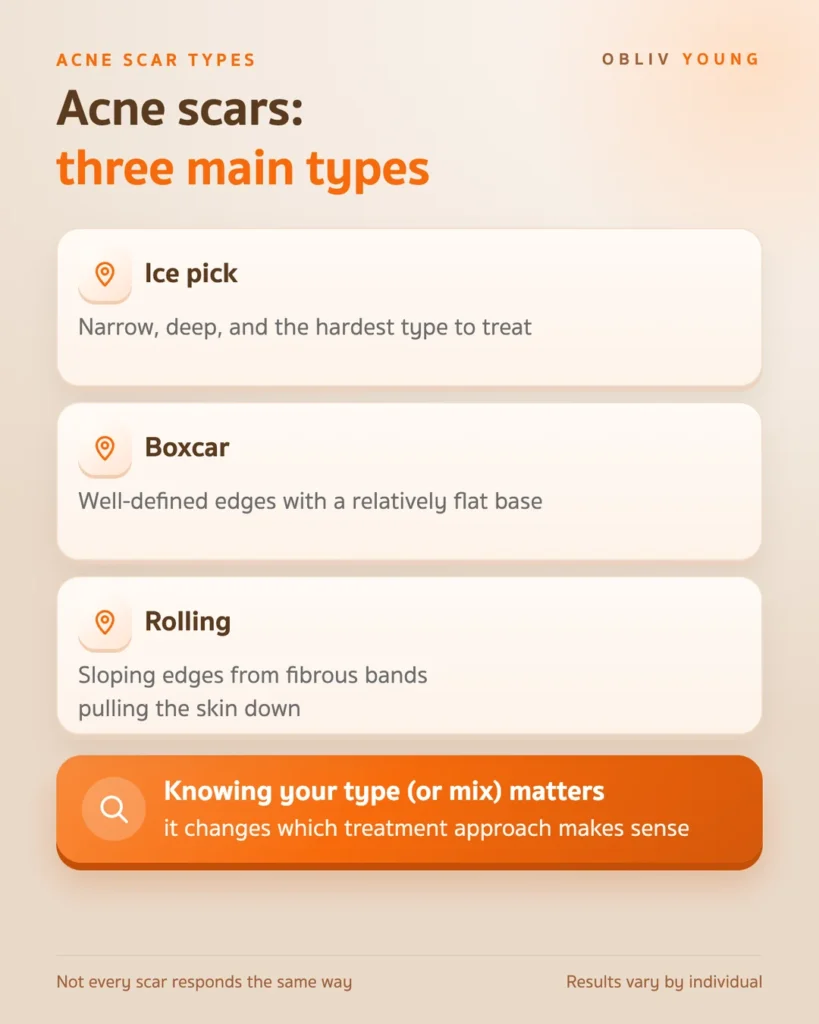
Dermatology generally groups atrophic acne scars into three types:
- Ice pick — narrow, deep, and the hardest type to treat
- Boxcar — well-defined edges with a relatively flat base
- Rolling — sloping edges caused by fibrous bands pulling the skin down from underneath
Knowing which type (or mix of types) you actually have matters, because it changes which treatment approach makes sense — not every scar responds to pico laser the same way.
How does pico laser work?
Pico laser delivers energy in extremely short pulses, measured in picoseconds — far shorter than older laser generations. That ultra-short pulse creates a mechanical, photoacoustic shockwave in the tissue rather than relying on sustained heat.
That shockwave breaks down unwanted pigment into finer particles while also triggering new collagen production in the treated area. Because it uses less heat than older technologies, it’s generally associated with shorter downtime and less irritation for many skin types.
At Obliv Young, we offer both Pico Majesty and Pico Alex, which use different wavelengths suited to different skin concerns — your doctor will recommend which one fits your scars during your assessment.
Can pico laser actually treat acne scars? Which types respond best?
Short answer: yes, but not equally across every scar type. Shallow-to-moderate scars like boxcar and rolling type tend to respond better to the collagen stimulation pico laser produces, because there’s still enough underlying collagen structure to build on.
Deep ice pick scars typically respond more slowly and may not fully resolve with pico laser alone. For deeper scarring, doctors often consider combining it with another deeper-acting treatment such as Sylfirm, which uses radiofrequency with fine needles to reach a deeper skin layer.
| Scar type | What it looks like | Approach usually considered |
|---|---|---|
| Boxcar | Sharp, defined edges, flat base | Responds fairly well to pico laser |
| Rolling | Sloping edges from fibrous tethering | Pico laser combined with a deeper treatment like Sylfirm |
| Ice pick | Narrow and deep | Needs further assessment — may need a different approach altogether |
This table is a general guide only. In practice, most people have a mix of scar types in the same area, so your doctor will scan your skin and build a plan around what’s actually there, not a generic category.
How many sessions before you see results?
Pico laser isn’t a one-and-done treatment for acne scars — new collagen takes time to form, and it needs repeated stimulation. A commonly seen pattern is a course of sessions spaced roughly 3 to 6 weeks apart, giving the skin time to recover and rebuild collagen between rounds.
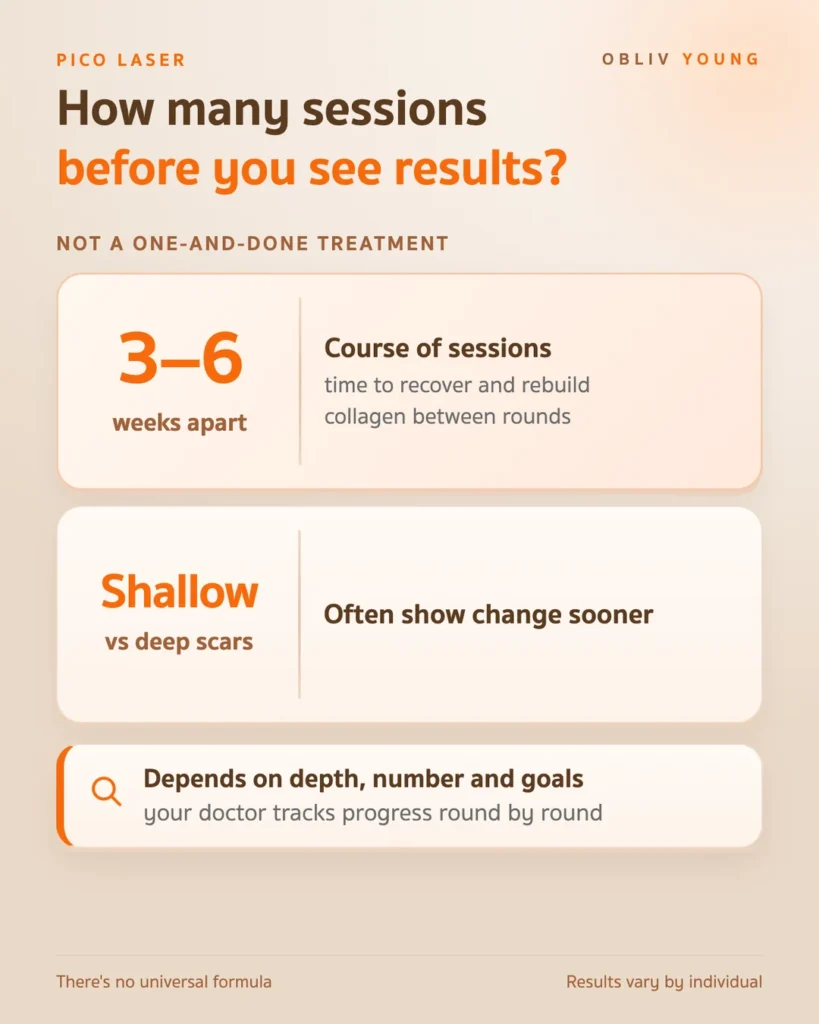
The right number of sessions depends on scar depth, how many scars there are, and your specific goals. Shallower scars often show change sooner than deep ones. There’s no universal formula here — your doctor will assess and track progress round by round.
What to consider before booking
First, you should view this as a course of treatment, not a quick fix — if you’re expecting a single session to resolve deep scarring, you’ll likely be disappointed.
Second, very deep ice pick scars may not fully respond to pico laser alone, and your doctor needs to assess whether a combination approach makes more sense for you.
Third, many people experience mild redness or a warm sensation right after treatment and usually settles within a short time, but this is still a medical procedure that should only be performed by a doctor — not something to attempt at home.
Fourth, if you still have active, inflamed acne, most doctors recommend getting that under control first before starting scar treatment, since treating inflamed skin isn’t the right timing and can trigger more inflammation.
What drives pico laser pricing?
There’s no single number that applies to everyone for acne scar treatment with pico laser, since pricing depends on several factors together:
- The treatment area and number of scars
- Scar depth and type (boxcar, rolling, ice pick)
- How many sessions your doctor plans for your full course
- Which pico laser device is used — Pico Majesty or Pico Alex
The most reliable way to get an accurate number is a direct consultation, where a doctor assesses your actual scars first. That gives you a quote based on your real treatment plan, not a blanket rate that may not match what you actually need.
Frequently asked questions
Do acne scars go away on their own?
Generally, no — scars formed from damaged collagen don’t fully resolve on their own. They may look slightly shallower over time as skin naturally changes, but that’s not the same as full resolution. Most people need a treatment that actively stimulates collagen to see meaningful improvement.
What’s the difference between shallow and deep acne scars in terms of treatment?
Shallow scars tend to respond to pico laser faster and more visibly. Deep scars take longer and, in some cases, need a combination approach. Your doctor should first assess scar depth accurately before building a treatment plan.
Do I need to treat active acne first before treating scars?
Most doctors recommend calming active, inflamed acne before starting scar treatment. Do not treat scar tissue while acne remains actively inflamed and can add to the inflammation instead of helping.
Are acne marks the same as acne scars?
Not quite. Acne marks usually refer to flat redness or dark discoloration where the skin surface is still even. Acne scars are actual depressions in the skin from collagen damage. Some people have both at once, and a doctor will assess each separately.
What’s the difference between Pico Majesty and Pico Alex?
Both are pico lasers, but they use different wavelengths suited to different concerns. Your doctor will recommend which one fits your specific scarring and skin tone during your assessment.
How do I choose where to get pico laser done in Bangkok?
The most important thing is a clinic that actually assesses your scars in person rather than selling a fixed package sight unseen. Ask which device model the clinic uses, confirming the treating doctor is licensed, and checking reviews from people who’ve actually had the treatment.
Acne scars won’t disappear just by waiting, but that doesn’t mean you need to book blind either. Talk to a doctor at Obliv Young Clinic about an in-person assessment of your scars so you know exactly which approach actually fits.

Related reading
This article was medically reviewed by
Mr. Park Young Jin
Education
Graduated with a Doctor of Medicine degree from Inha University College of Medicine, and completed an executive program at Seoul National University. Gained experience as a Public Doctor within the government sector before advancing into Aesthetic Medicine with leading Korean clinic groups, including Forever Plastic Surgery, Ppeum Clinic, and Y&I Clinic, serving as a physician and Senior Doctor
Specializes in
Specializes in Aesthetic Medicine, Facial Contouring, and Facelifting Techniques, serving as President of the Obliv Clinic Network (Incheon, Bangkok, Dubai). Also active in the academic community as Academy Director of the Korean Aesthetic Surgery & Laser Society and Senior Director of the Korean Academy of Facelifting and Contouring , as well as a Global KOL and Key Doctor for leading brands including Wontech, MERZ, Jetema, Amalian, and Gouri, covering Filler, Energy-Based Devices, and Skin Rejuvenation technologies internationally. Source: Aestheticsa