What Is the 7-Layer Skin Framework? How Many Layers Does Skin Have

Why the 7-layer framework matters
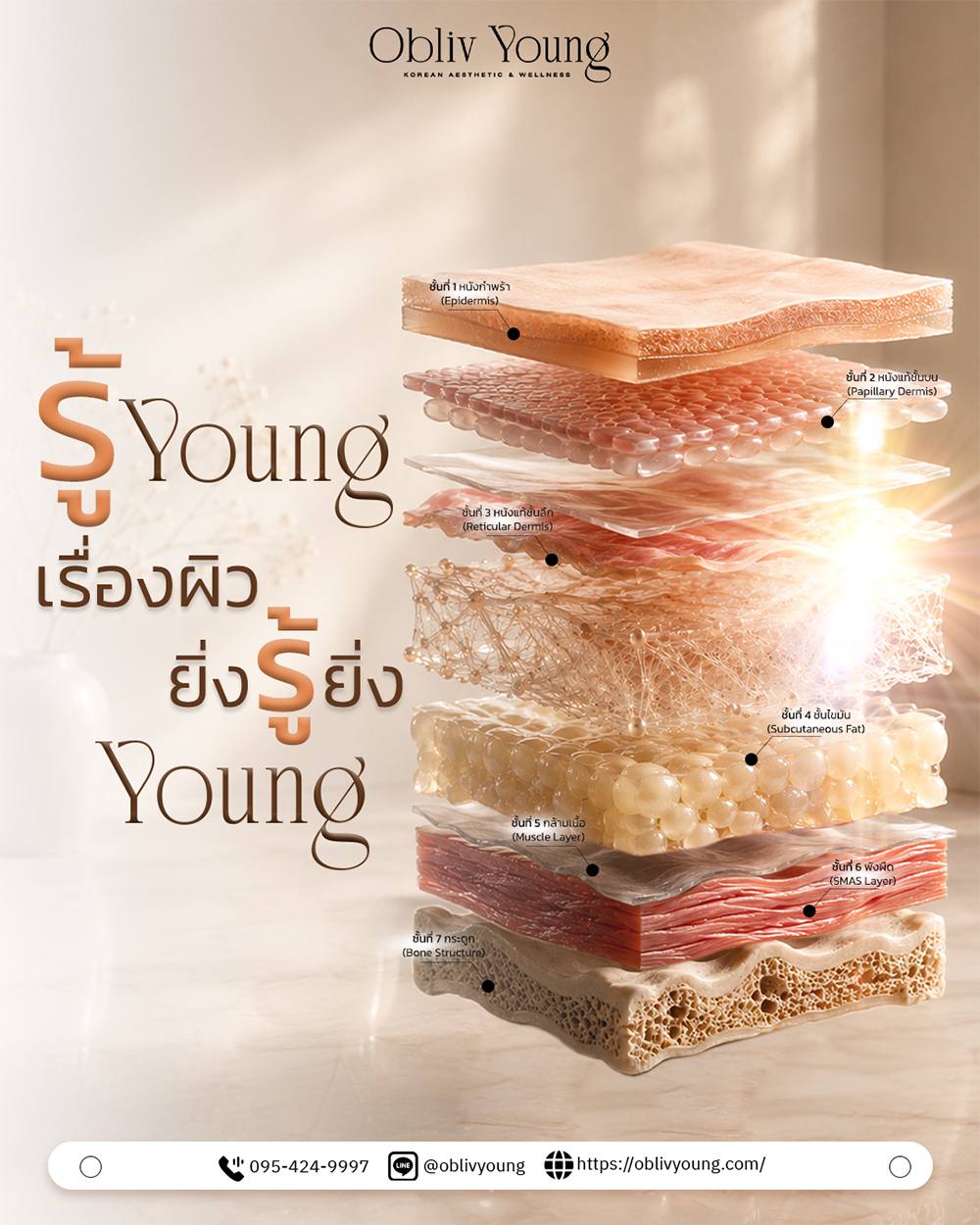
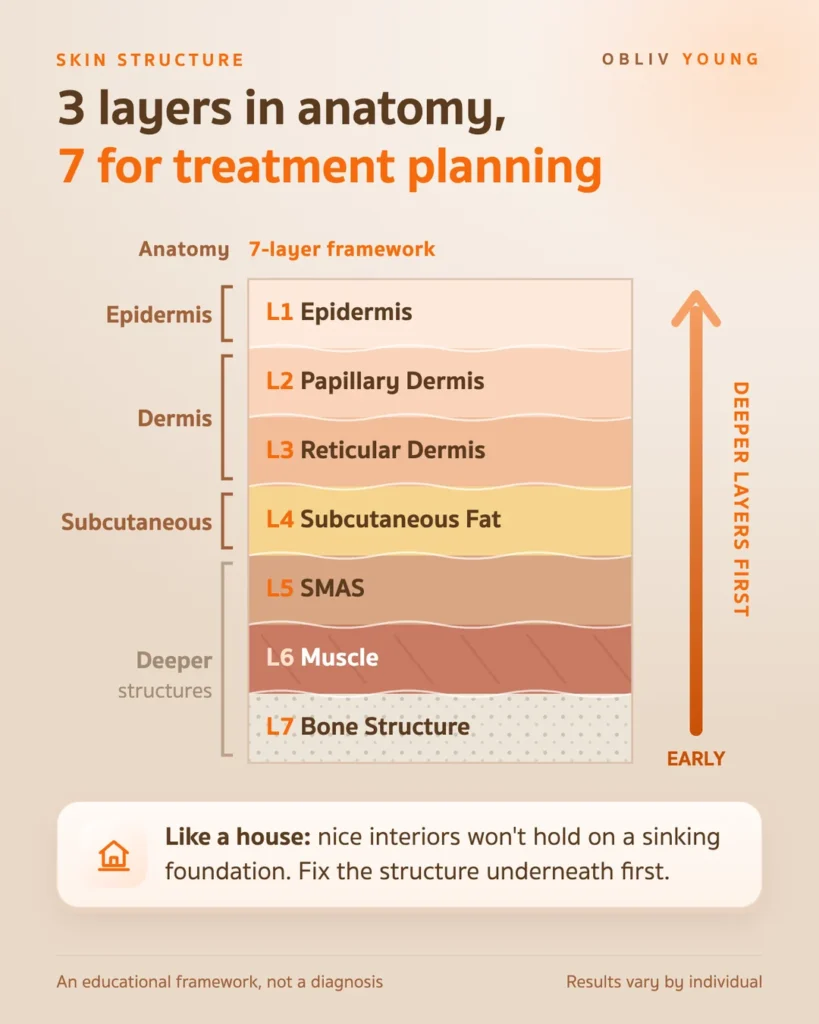
In standard anatomy, anatomists commonly describe skin as three main layers: the epidermis, dermis and subcutaneous tissue. Obliv Young uses a seven-layer framework to discuss the deeper structures that also influence facial appearance. These include fascia, muscle, fat and bone. This framework is an educational way to organise treatment questions. It is not a medical diagnosis and does not mean every concern needs treatment at every layer.
The standard medical answer is 3 main layers: epidermis, dermis and subcutaneous tissue. But for planning an actual aesthetic treatment, 3 layers aren’t detailed enough. They don’t say exactly where a concern should be addressed. That is why Obliv Young Clinic uses a 7-layer framework to decide which layer a treatment should target.
How the 7-layer framework relates to treatment questions
The framework helps keep a consultation clear. Muscle-related movement, loss of volume, laxity, skin texture and uneven tone are not the same concern. A treatment name alone does not identify the layer or cause.
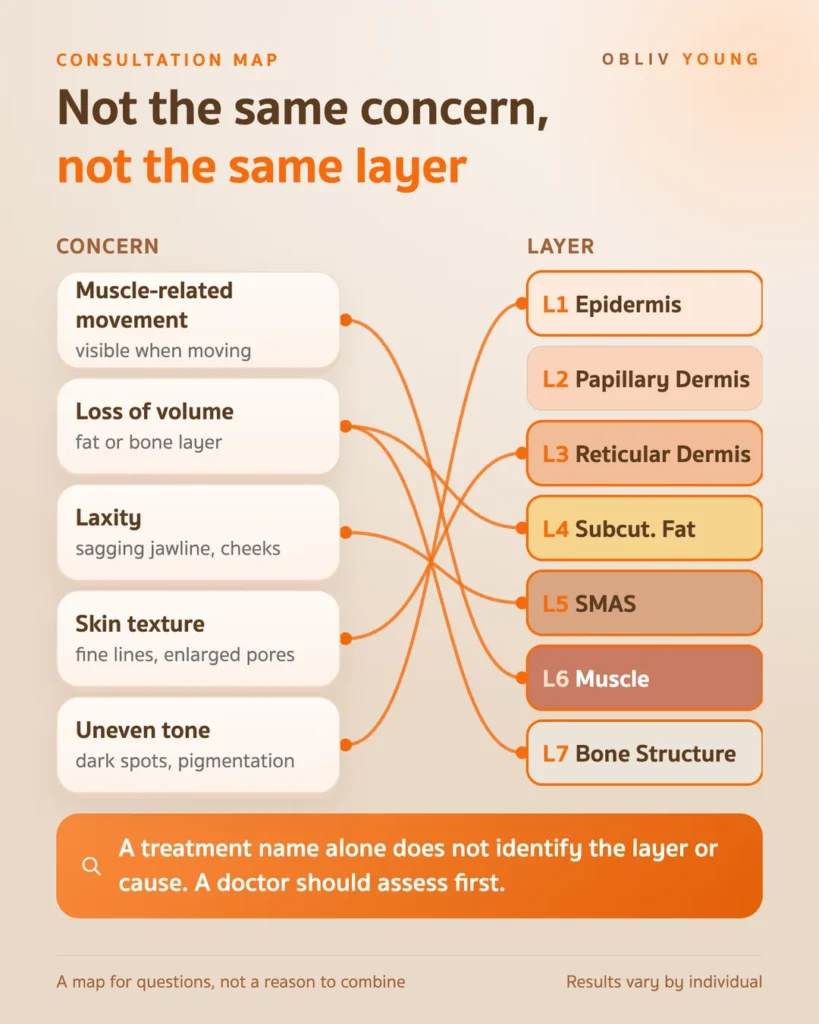
Use the framework as a map for questions, not as a reason to combine treatments. A doctor should assess the concern, skin condition, medical history and realistic goal before recommending an approach.
Main points
- Standard medical anatomy describes skin as 3 main layers, but Obliv Young breaks it into 7 for treatment planning
- The principle: address deeper layers before shallower ones, not whichever treatment is trending
- Each layer has its own specific concerns and matching treatments
- A doctor should assess which layer your concern actually sits in before recommending a treatment
What skin structure is, and why we break it into 7 layers
Obliv Young Clinic uses a 7-layer skin framework to assess each patient’s concern. It is based on the real anatomical layers of the face from the bone structure up to the outermost skin. The general principle is to address deeper layers before shallower ones. If the underlying structure isn’t addressed, working on the surface alone won’t deliver a fully balanced result. It’s a bit like decorating a house with a sinking foundation.
no matter how nice the interior looks, you’ll eventually have to go back and fix the structure underneath. Many people assume the “most popular” or “most talked-about” treatment must be the right one. However, a treatment that suits one person may do very little for another, simply because their concerns sit in different layers entirely. Here’s how each commonly searched treatment maps to a specific layer. It also shows why treating the right layer matters more than chasing a trend.
Layer 7: Bone Structure
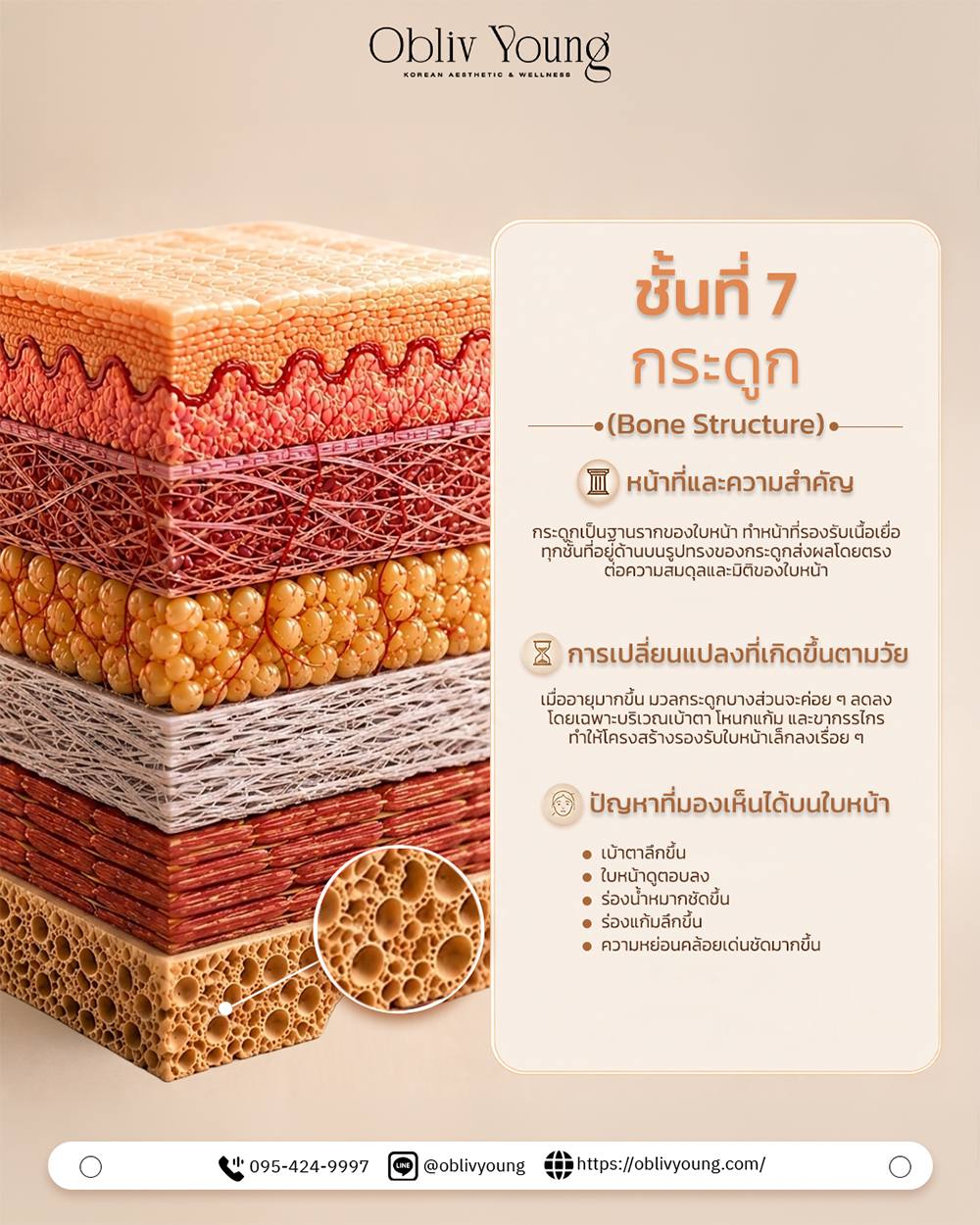
The deepest layer, and the most overlooked. it’s invisible to the eye and rarely crosses anyone’s mind when they first think about “getting work done.” Bone is the actual foundation of the face, supporting every layer of tissue above it. As we age, bone mass gradually decreases, especially around the eye sockets, cheekbones, and jaw. the underlying reason eye sockets look deeper, cheeks look flatter, nasolabial folds appear more defined, or the face looks sunken even without any weight loss.
Many people try to fix this by treating the skin or fat layer alone, and end up disappointed that the result doesn’t hold, simply because the root cause. the bone structure underneath. received no attention. Doctors typically address this layer with Sculptra, which gradually stimulates the body’s own collagen production rather than adding volume instantly. They may also use a deep-plane filler technique placed at the supra-periosteal level by a doctor. This is a precise, structurally-aware technique that requires real anatomical expertise. Read more about Sculptra.
Layer 6: Muscle
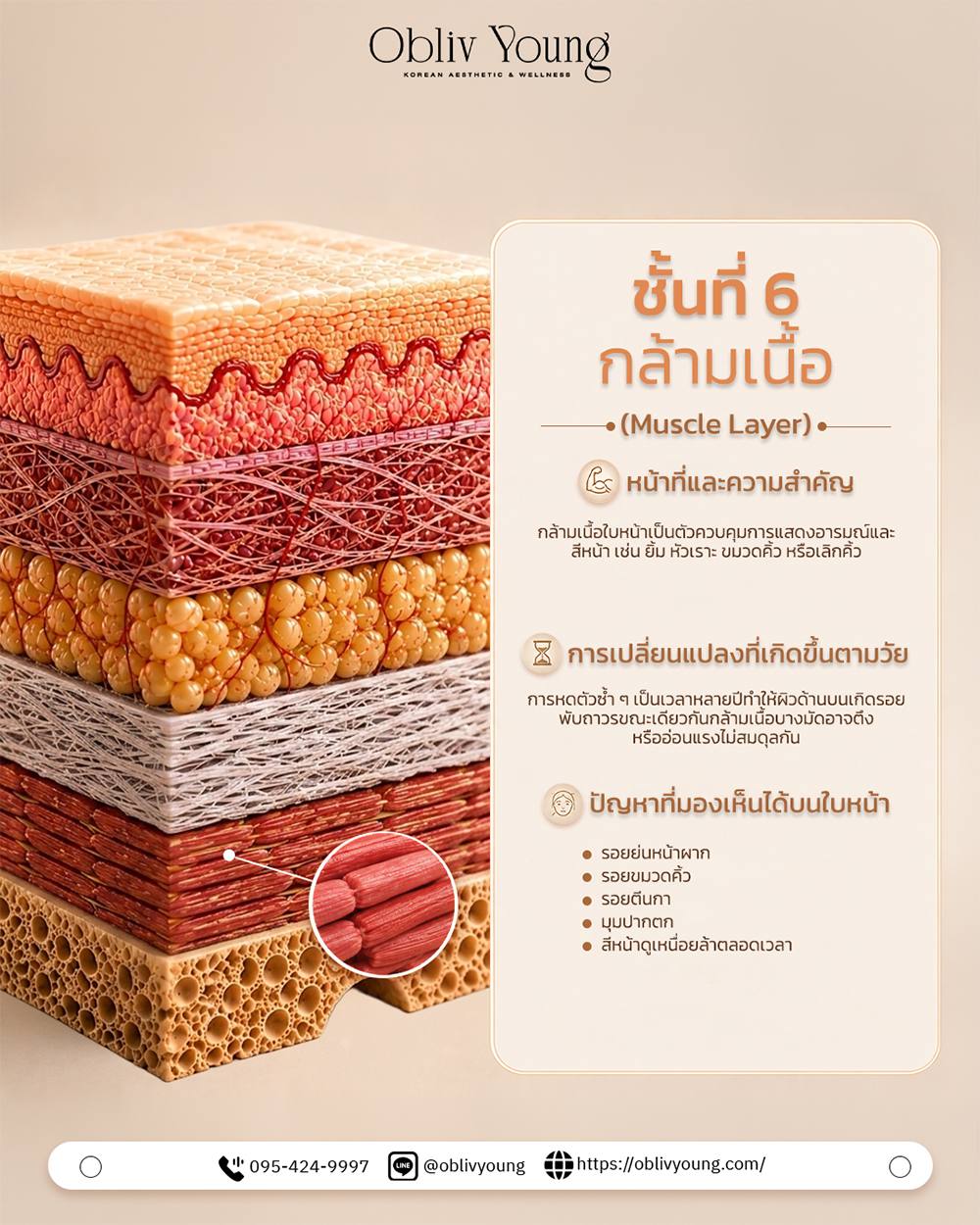
Facial muscles control expression. smiling, frowning, raising eyebrows, or even unconscious teeth clenching. Years of repeated contraction eventually create permanent creases in the skin above. These include forehead lines, frown lines, crow’s feet, or a downturned mouth. What sets this layer apart from others is that these lines are usually most visible while the face is actively moving (dynamic wrinkles) and can soften or disappear at rest. This is a sign the root cause is muscle activity, not volume or collagen loss deeper down.
Anti-wrinkle injections work by temporarily reducing muscle activity in the treated area, softening expression-driven lines and slimming a jaw that’s become bulky from teeth clenching. Worth knowing: this approach works best for dynamic wrinkles specifically. If a line is still visible even with the face completely at rest, this is usually a sign that another layer needs addressing too. A doctor determines the injection sites and amount needed to soften lines while keeping the face looking natural and expressive, not frozen. Read more under the Anti-Wrinkle category.
Layer 5: SMAS (Superficial Musculoaponeurotic System)
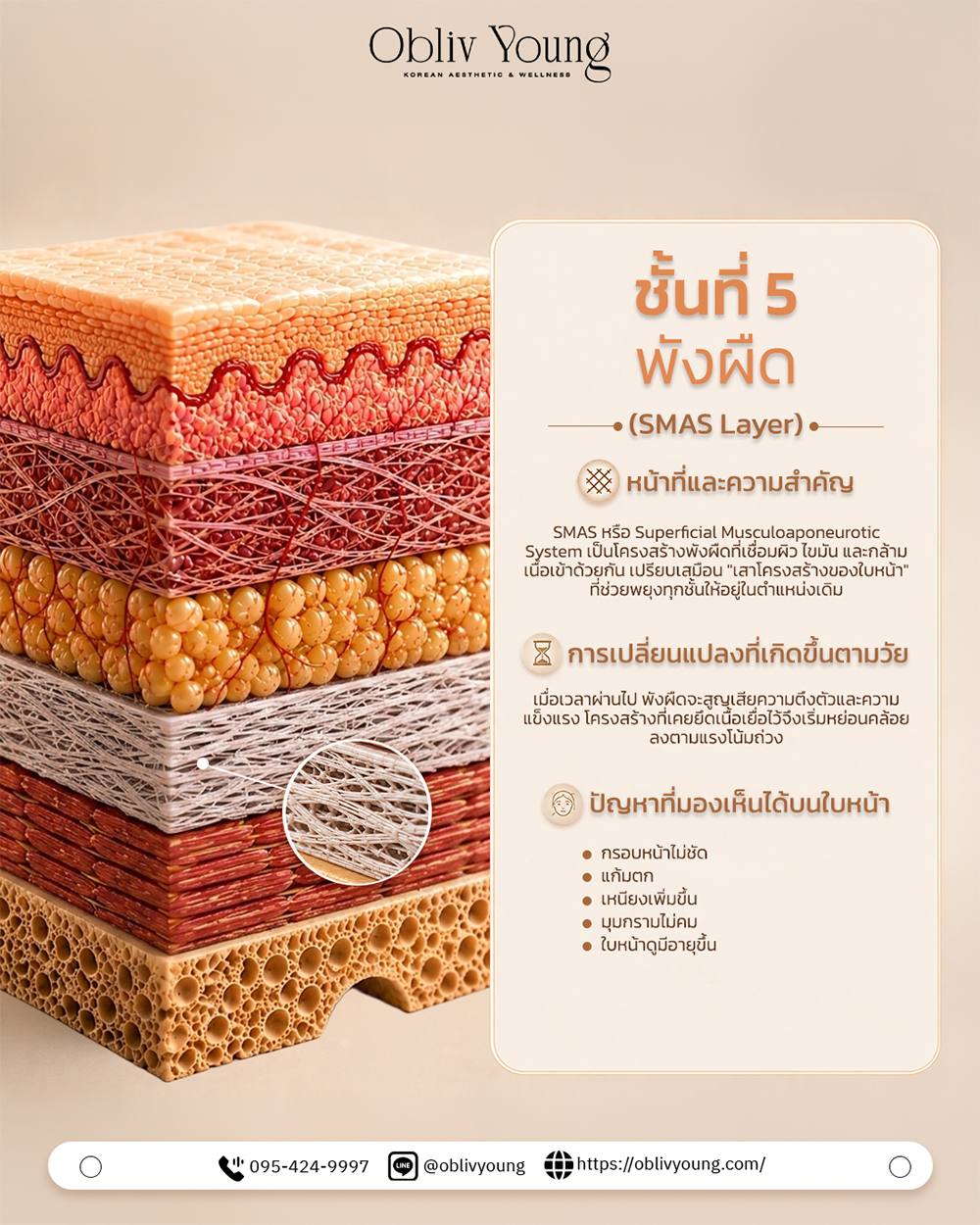
SMAS is the fascia structure connecting skin, fat, and muscle. It is like the scaffolding that holds every layer above it in place. It’s the same layer a surgical facelift physically repositions; non-surgical treatments aim to stimulate this same layer to tighten on its own instead. Over time this fascia loses tension, and the structure that once held tissue in position starts to sag. This shows up as a less defined jawline, drooping cheeks, more visible jowls, or a less sharp jaw angle. That is the main reason people say they look older even when their skin still looks fine on its own.
Ultraformer MPT uses HIFU technology to deliver heat energy directly into this layer without needles or surgery. It creates tiny, precisely-placed thermal points that trigger tissue contraction and new collagen formation. Thread lifting instead uses dissolvable threads placed under the skin to support the structure immediately. This creates a more instant lifting effect, though with a different downtime profile. Clinicians usually do both early in a treatment plan, since they address the most structurally foundational layer in this list. A doctor can help assess which suits your degree of sagging. and your tolerance for downtime. better. Read more on the Ultraformer MPT and Thread Lifting service pages.
Layer 4: Subcutaneous Fat
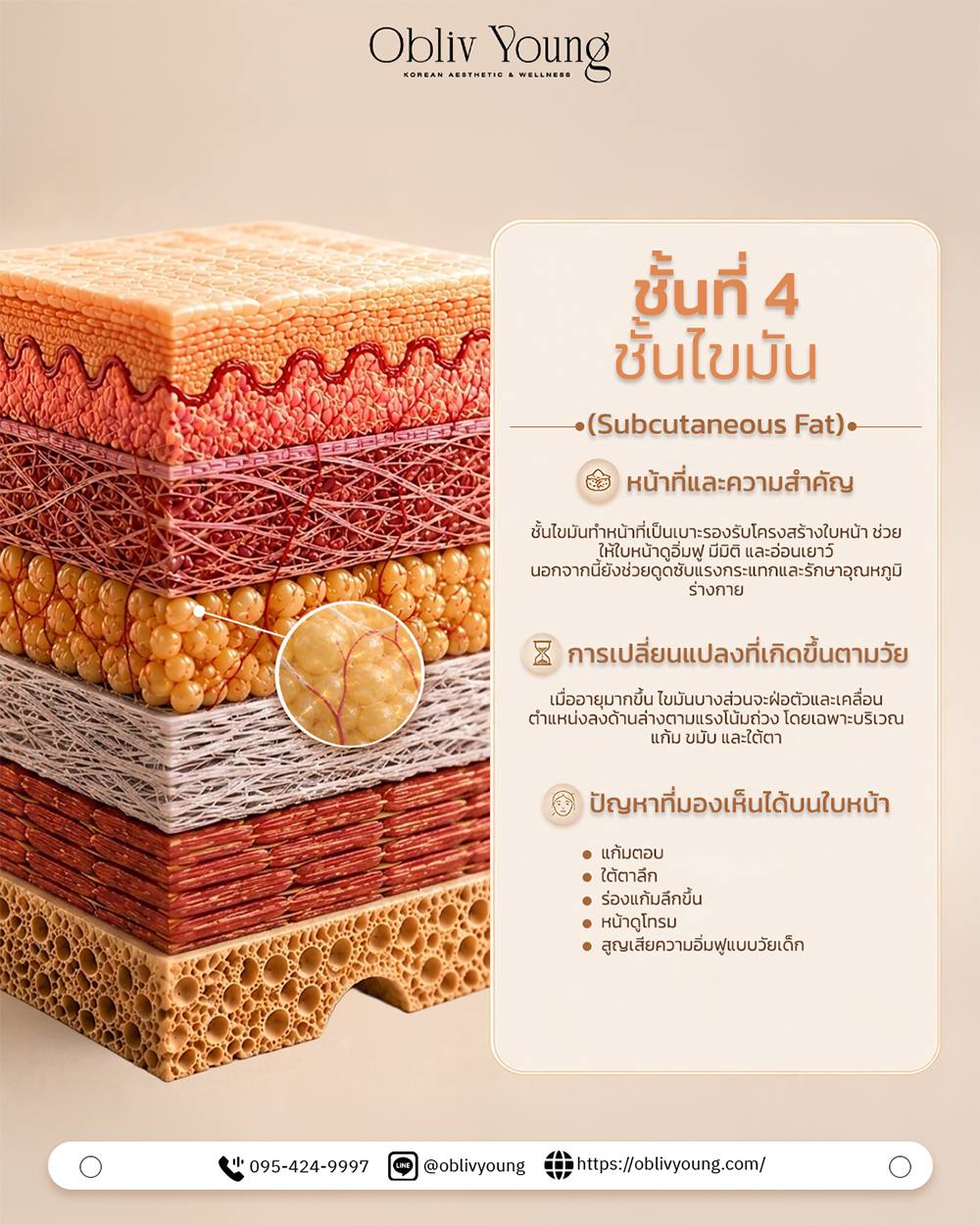
The fat layer acts as a cushion supporting facial structure, giving the face a fuller, more youthful dimension. This isn’t just about body weight, as many assume. As we age, fat in this layer gradually atrophies and shifts downward with gravity. This is especially true around the cheeks, temples, and under the eyes. It can lead to sunken cheeks, hollow under-eyes, and a deeper nasolabial fold, even without any actual weight change. This is exactly where people often confuse fat-layer volume loss with bone-layer volume loss, since the visible symptoms (hollow cheeks, deep folds) look almost identical, even though the root cause sits in a different layer.
Filler most directly addresses this by restoring volume exactly where it’s been lost, delivering a visible, tangible result immediately after injection. Sculptra at the bone layer instead relies on the body’s own gradual collagen response. Filler tends to suit people who want a faster, more immediately visible outcome and have a clearly localized concern, while Sculptra suits those after a more gradual, structural long-term change. In some cases a doctor may recommend both together, since they address different layers that still influence each other. Read more about filler options under the Filler category.
Layer 3: Reticular Dermis
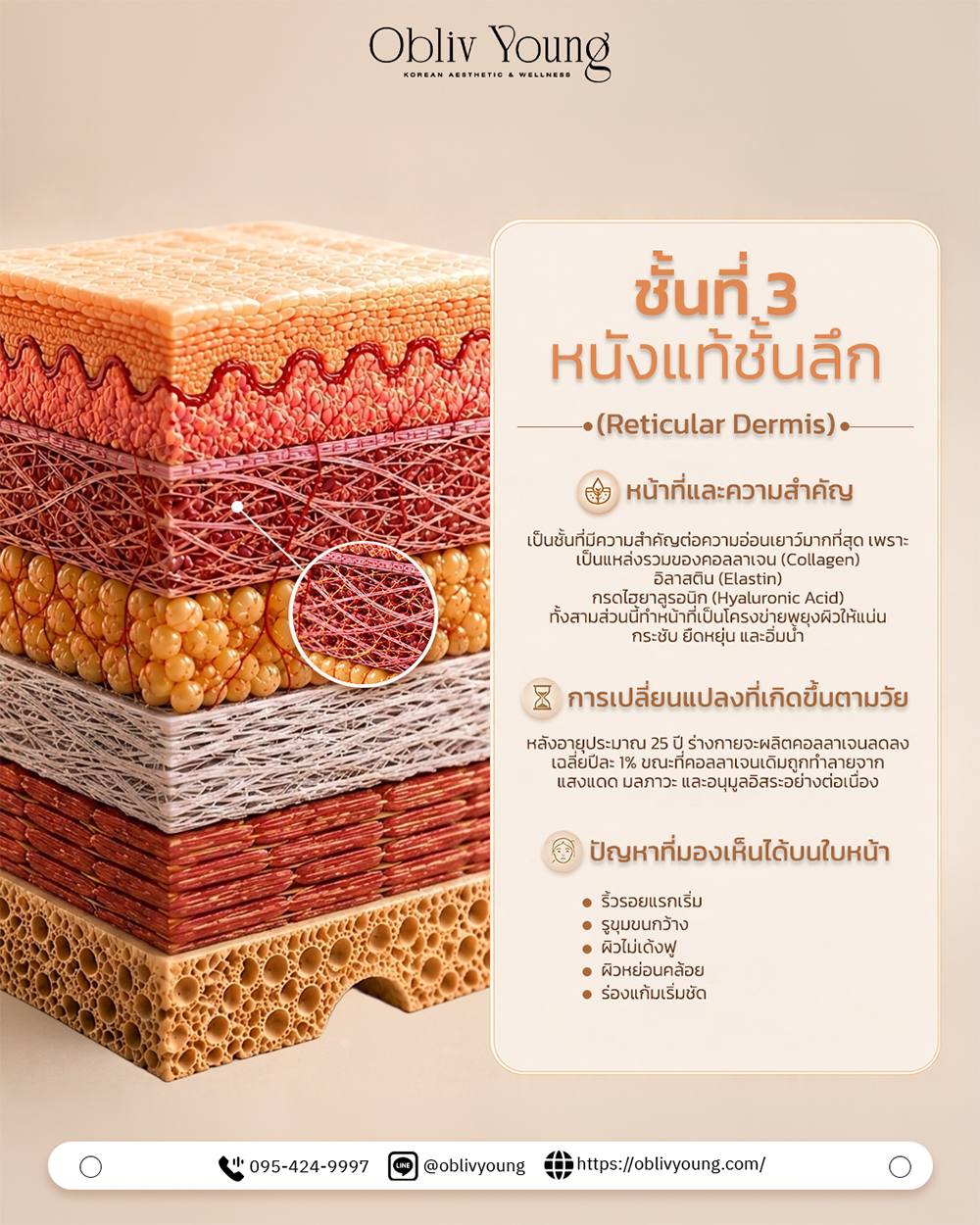
One of the most important layers for youthful-looking skin, since it’s where collagen, elastin, and hyaluronic acid are concentrated. These form the network that keeps skin firm, resilient, and hydrated. After around age 25, the body’s collagen production drops by roughly 1% per year. Meanwhile, existing collagen simultaneously breaks down from sun exposure and pollution. These are two forces working against each other continuously. The visible result is early fine lines, enlarged pores, less bounce in the skin, and the first faint signs of a nasolabial fold. These are not yet as deep as what you’d see from fat or bone-layer loss.
Oligio and OligioX use radiofrequency (RF) energy to stimulate this layer directly. The two differ in how energy is delivered and how deep it reaches. A doctor selects between them based on the individual’s skin condition. Both help skin look firmer while encouraging ongoing collagen activity rather than a one-time effect. Unlike filler, which adds volume from the outside, this category works by prompting the skin to rebuild its own structure. So results tend to build gradually rather than appear instantly. Read more on the Oligio and OligioX service pages.
Layer 2: Papillary Dermis
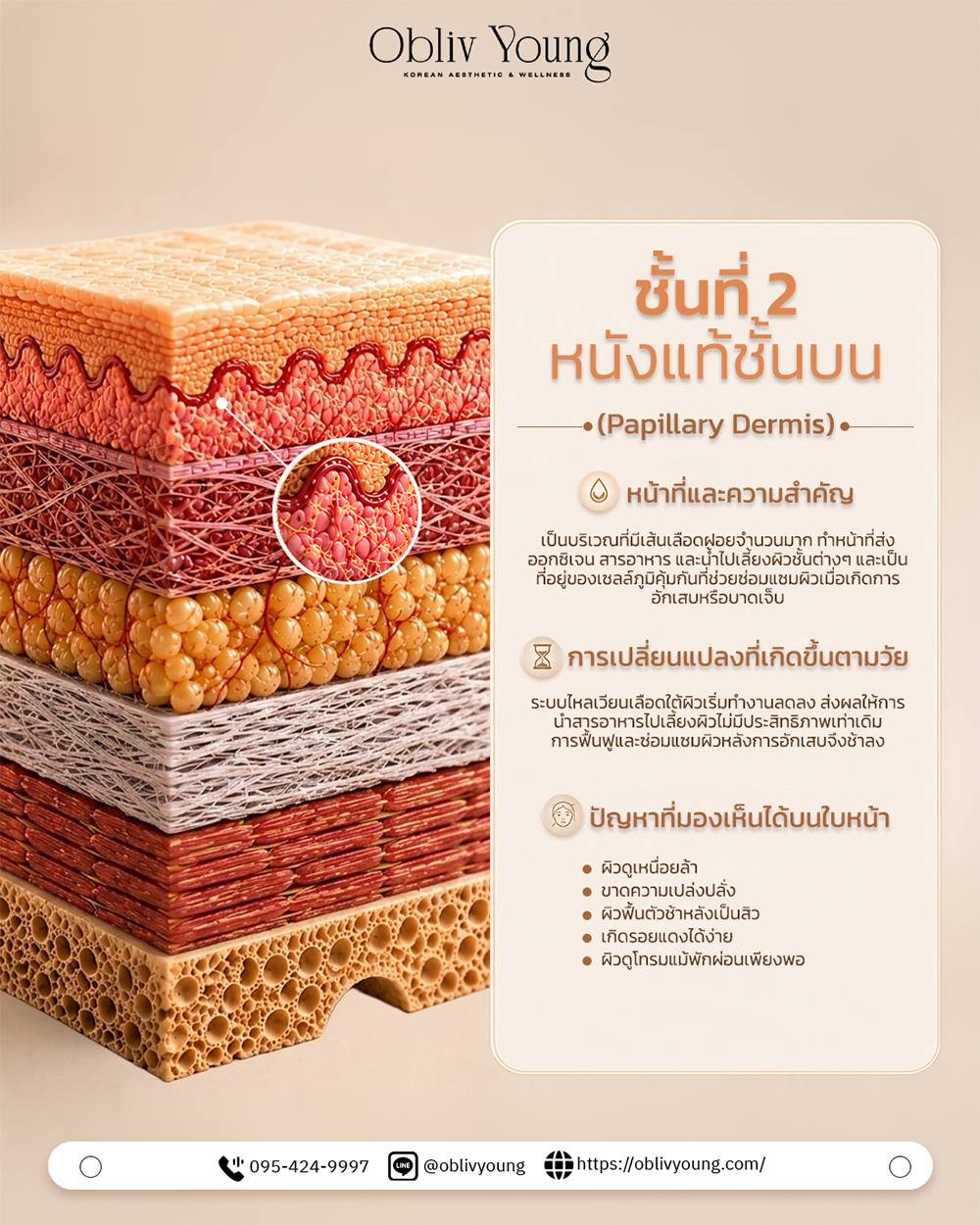
This layer is rich in capillaries that deliver oxygen, nutrients, and moisture to the skin above, and is home to the immune cells that help repair skin after inflammation or injury. This is essentially the skin’s own delivery system. As circulation in this layer slows down with age, delivering nutrients becomes less efficient, and recovery after breakouts or irritation takes longer. The result: skin looks tired, loses its radiance, flushes more easily, and bounces back more slowly than it used to, even with adequate rest.
Skin boosters work in this layer directly, using a different mechanism from the filler or lifting treatments described above. The focus isn’t structure or volume, but skin quality and the skin’s own repair system. This suits people dealing with dry, dull, or chronically dehydrated skin that doesn’t seem to improve no matter how much topical skincare is applied. We recently published a detailed comparison of the skin booster names on the market. read it at Juvelook, Vitaran, Rejuran, and Gouri: Which Skin Booster Fits Your Skin Goals?
Layer 1: Epidermis
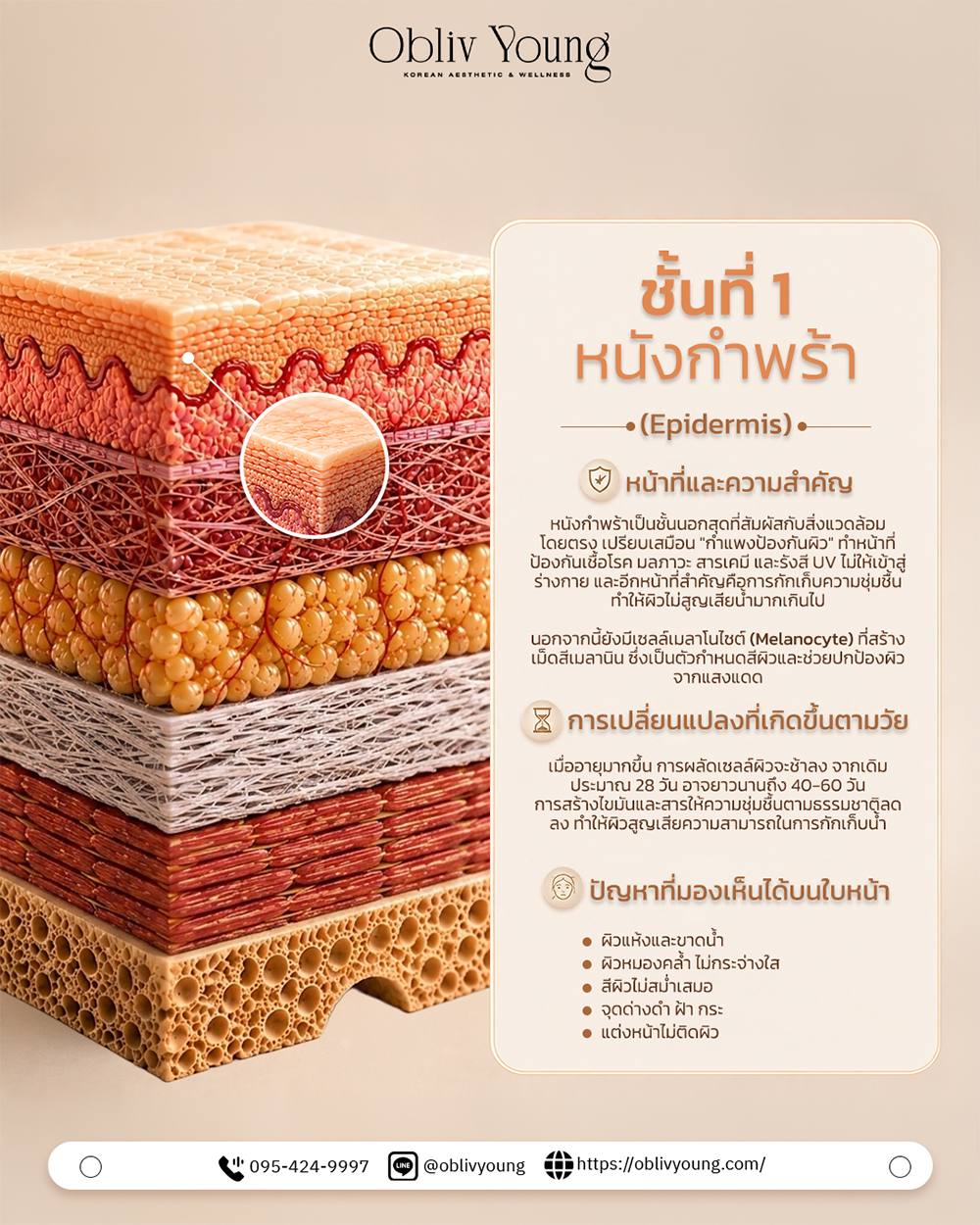
The outermost layer, the first to be seen and touched. It acts as a barrier against germs, pollution, and UV radiation, while locking in moisture so skin doesn’t lose too much water, and contains the melanocyte cells that produce melanin. the pigment that determines skin tone and helps protect against sun damage. As we age, skin cell turnover slows from roughly 28 days to as long as 40–60 days. Natural oil and moisture production declines too. These changes lead to dryness, dullness, uneven tone, the first dark spots or pigmentation, and makeup that doesn’t seem to sit as well as it used to.
This is usually the first layer people try to fix with skincare alone, but sometimes the concern runs deeper than a topical product can reach. Pico Laser uses high-speed laser energy to specifically address dark spots and uneven tone. Sylfirm uses RF microneedling to target redness and enlarged pores. It also tends to suit more sensitive skin than a standard Pico Laser session. Clinicians usually use these two as the last step in a treatment plan, since they refine the surface after the structural layers underneath are already addressed. Doing them too early, before deeper concerns are resolved, often means the results don’t hold as well. Read more on the Pico Laser and Sylfirm service pages.
Frequently asked questions
How many layers does skin actually have?
If you’re talking about just the epidermis and dermis, medical anatomy describes 3 main layers. The total comes to 7, including the fascia, muscle, and bone that sit deeper and affect facial structure. This is the framework Obliv Young Clinic uses to assess concerns.
What is SMAS and why does it matter?
SMAS is the fascia layer connecting skin, fat, and muscle. acting like scaffolding that holds the face in position. It’s the same layer a surgical facelift directly repositions; non-surgical treatments instead stimulate this layer to tighten on its own.
What’s the difference between the dermis and epidermis?
The epidermis is the outermost layer, protecting against the environment and locking in moisture. The dermis sits deeper and holds the collagen and elastin that keep skin firm. A concern at the surface and a concern in the dermis need very different treatments.
Do I need to know which layer my concern is in before every treatment?
Not in detail yourself. but a doctor should assess it. A treatment suited to one layer may do nothing at all if the actual concern sits in a different one.

Related reading
- Juvelook, Vitaran, Rejuran, and Gouri: Which Skin Booster Fits Your Skin Goals?
- Popular Aesthetic Treatments 2026: By Category
- Filler by Facial Area: Which Brand Fits Where
Last updated: August 31, 2026
Frequently Asked Questions
What is the 7-layer skin framework?
The 7-layer framework divides facial anatomy into seven structural layers from skin surface to bone: epidermis, dermis, subcutaneous fat, SMAS, facial muscles, deep fat compartments, and bone. Understanding these layers helps plan treatments that target the right depth.
Why does layer depth matter for treatments?
Different treatments work at different depths. Surface treatments like chemical peels affect the epidermis. Lasers reach the dermis for collagen. Fillers go into subcutaneous fat or deep compartments. Knowing the layer ensures the treatment targets the actual problem.
Which layer causes wrinkles?
Wrinkles come from multiple layers. Fine lines are mainly dermal collagen loss. Deeper folds involve fat volume loss in subcutaneous and deep compartments, plus bone resorption. That is why fixing deep wrinkles often needs volume replacement, not just surface treatment.
Can I treat all layers at once?
Yes, but it requires a comprehensive plan. For example, treating aging might combine surface resurfacing (epidermis), collagen stimulation (dermis), and filler for volume (deep fat). A skilled practitioner layers treatments to address multiple depths safely.
This article was medically reviewed by
Mr. Park Young Jin
Education
Graduated with a Doctor of Medicine degree from Inha University College of Medicine, and completed an executive program at Seoul National University. Gained experience as a Public Doctor within the government sector before advancing into Aesthetic Medicine with leading Korean clinic groups, including Forever Plastic Surgery, Ppeum Clinic, and Y&I Clinic, serving as a physician and Senior Doctor
Specializes in
Specializes in Aesthetic Medicine, Facial Contouring, and Facelifting Techniques, serving as President of the Obliv Clinic Network (Incheon, Bangkok, Dubai). Also active in the academic community as Academy Director of the Korean Aesthetic Surgery & Laser Society and Senior Director of the Korean Academy of Facelifting and Contouring , as well as a Global KOL and Key Doctor for leading brands including Wontech, MERZ, Jetema, Amalian, and Gouri, covering Filler, Energy-Based Devices, and Skin Rejuvenation technologies internationally. Source: Aestheticsa