Rejuran Treatment Guide: What You Must Know Before Starting


Rejuran Guide: What It Is, What It Helps With, and How the Course Works
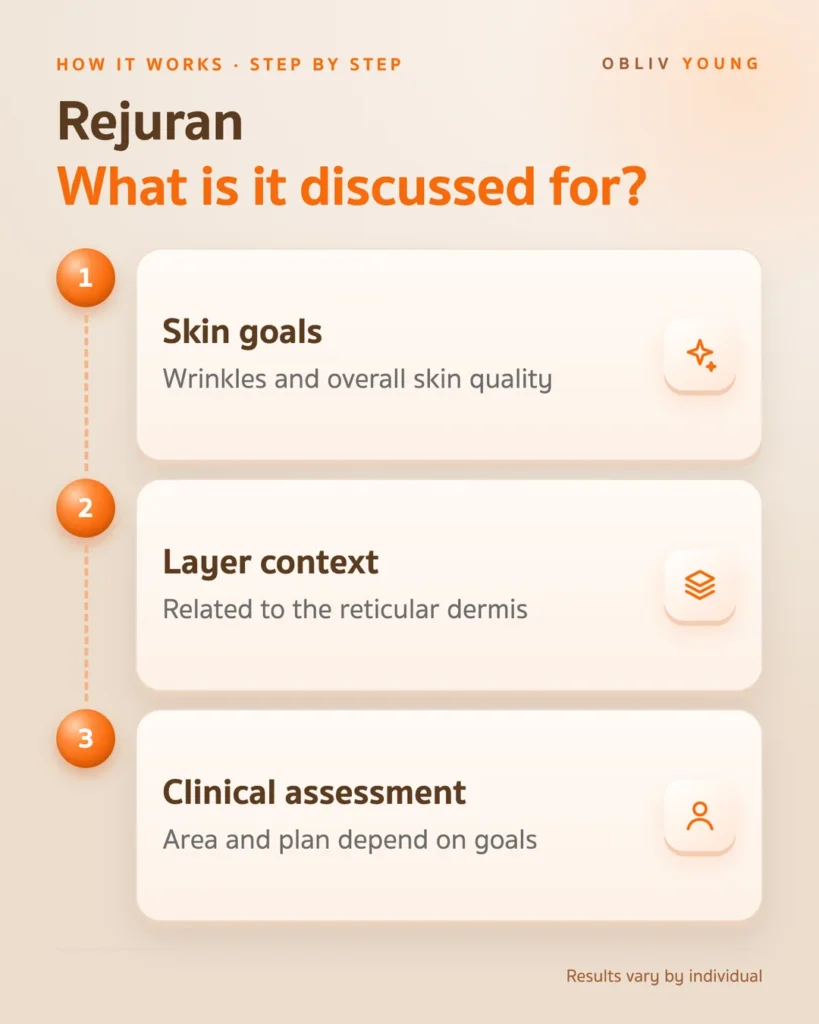
Clinicians discuss Rejuran, a group of injectable products, for wrinkles, skin texture, elasticity or firmness, and overall skin quality.
The protocol is one injection per month for three consecutive months; 2 cc is used for a specific area and 4 cc for the whole face.
A clinician should assess the area and explain the plan before treatment.
Quick summary
- People discuss Rejuran in the context of wrinkles, texture, elasticity or firmness, and overall skin quality.
- The course is one treatment each month for three consecutive months.
- The stated framework uses 2 cc for a specific area and 4 cc for the whole face; discuss a 2 cc whole-face distribution with the clinician and accept the outcome as explained.
- After the completed course, the duration may be 6–8 months.
- Vitaran/Rejuran maintenance may continue once a month according to the patient’s needs, after discussion with a clinician.
- Disclose health history and current medicines before treatment, and handle the treated area gently afterward.
Read the section that fits your question
- What is Rejuran?
- What does Rejuran help with?
- Who may be considering it?
- How many sessions and how many cc?
- How long may the result last and what comes next?
- What should you check before and after treatment?
- Frequently asked questions
What is Rejuran?
People use the name Rejuran for a group of injectable products discussed for wrinkles and overall skin quality.
The treatment relates to Layer 3, or the reticular dermis, a deeper dermal layer associated with collagen and elastin structure and with skin elasticity and firmness as skin ages.
The decision about treatment area, volume, and plan should begin with the person’s goals and a clinician’s assessment. The protocol values in this guide are not a substitute for an individual treatment decision.
What does Rejuran help with?
People may consider Rejuran in relation to:
- Facial wrinkles
- Uneven-looking skin texture
- Skin elasticity or firmness
- Overall skin quality
These are treatment goals, not a guarantee of a particular result. The assessment and the goal being discussed determine the relevant area and plan.
Who may be considering Rejuran?
Rejuran may be considered by people whose goals involve wrinkles or overall skin quality and who are prepared to discuss the area, volume, and plan with a clinician before deciding.
Before treatment, disclose relevant health information and current medicines. Disclose infection or inflammation at the intended area, allergies, pregnancy or breastfeeding, medical conditions, and medicines that may increase bleeding. Do not stop regular medicine without advice from the prescriber.
How many sessions and how many cc?
The course is one treatment per month for three consecutive months. The volume framework is:
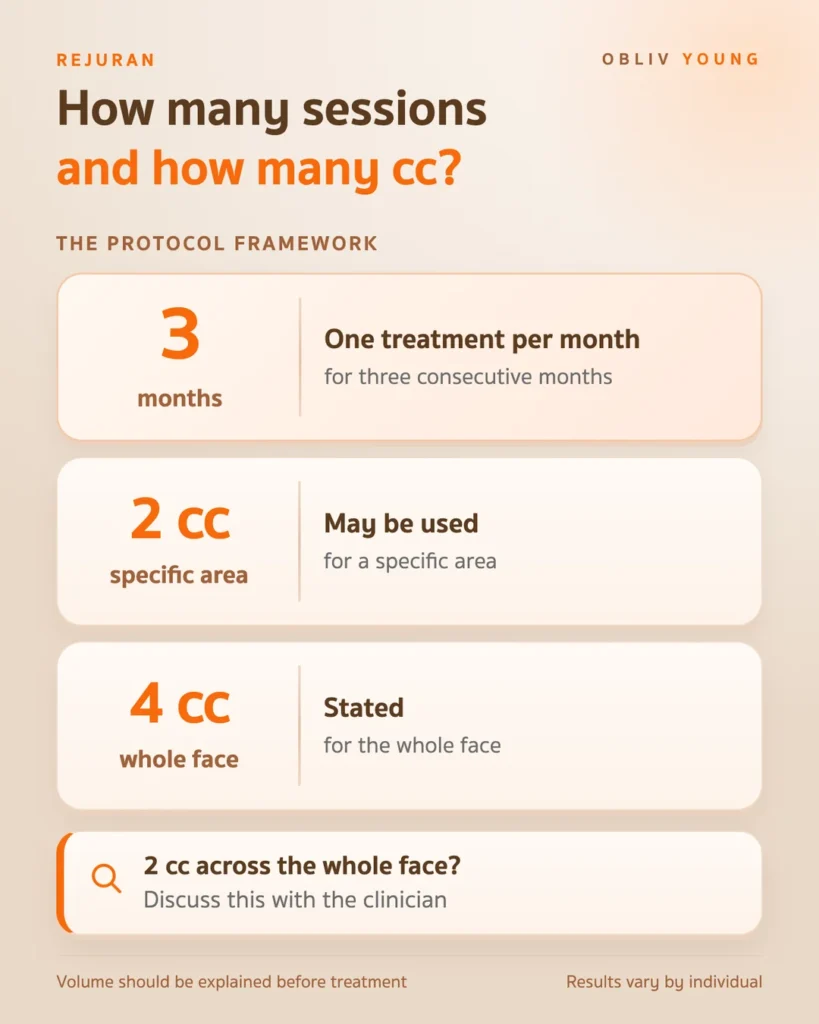
- Specific area: Clinicians may use 2 cc for a specific area.
- Whole face: The stated volume for the whole face is 4 cc.
- 2 cc distributed across the whole face: discuss this with the clinician and accept the outcome as the clinician explains it.
The clinician should explain the volume and distribution before treatment. Personal planning adds an assessment step; it does not replace the protocol framework above or create new values.
How long may the result last and what comes next?
After the completed protocol, the duration is 6–8 months. Vitaran/Rejuran may be maintained once a month according to the patient’s needs.
Use these points as questions for a clinician rather than as an automatic schedule for every person. Discuss any ongoing plan in relation to the treatment goal and the person’s assessment.
What should you check before and after treatment?
Before treatment, disclose allergies, pregnancy or breastfeeding, medical conditions, infection or inflammation at the intended area, and medicines or supplements you use. Ask the clinician to explain the area, goal, volume, and follow-up before deciding.
After treatment, follow the clinic’s instructions and handle the injection area gently.
Avoid pressing, massaging, picking, or squeezing it.
Use gentle products as advised and avoid heat, friction, or other irritants according to the instructions you receive.
Do not add medicines, creams, or supplements yourself, and do not stop regular medication without speaking with the prescriber.
If the injection-area symptoms worsen rapidly or you have difficulty breathing, seek emergency medical care immediately. For routine aftercare questions, use the follow-up channel provided to you.
A practical consultation checklist
Before a discussion, note your main skin goal, the area that concerns you, your health history, allergies, and current medicines or supplements.
Ask which volume applies to the intended area, how the distribution will be explained, and what follow-up instructions you should receive.
The clinician’s assessment should clarify the plan before treatment.
Frequently asked questions
What is Rejuran?
Clinicians discuss Rejuran, a group of injectable products, for wrinkles and overall skin quality; they decide the area and plan after assessment.
What is the Rejuran course?
The course is one treatment per month for three consecutive months.
How many cc are used?
The stated framework is 2 cc for a specific area and 4 cc for the whole face. If the clinician plans to distribute 2 cc across the whole face, discuss it and understand the explained outcome before treatment.
How long does the completed protocol last?
The duration may be 6–8 months after the completed protocol. Vitaran/Rejuran may be maintained once a month according to the patient’s needs, after discussion with a clinician.
What should you do after Rejuran?
Follow the instructions provided to you, handle the injection area gently, and avoid pressing, massaging, picking, or squeezing it. Seek emergency care for rapidly worsening injection-area symptoms or difficulty breathing.
CTA: If you are considering Rejuran, prepare your goals, intended area, health history, and current medicines for a discussion with an appropriate clinician before deciding.
This article was medically reviewed by
Mr. Park Young Jin
Education
Graduated with a Doctor of Medicine degree from Inha University College of Medicine, and completed an executive program at Seoul National University. Gained experience as a Public Doctor within the government sector before advancing into Aesthetic Medicine with leading Korean clinic groups, including Forever Plastic Surgery, Ppeum Clinic, and Y&I Clinic, serving as a physician and Senior Doctor
Specializes in
Specializes in Aesthetic Medicine, Facial Contouring, and Facelifting Techniques, serving as President of the Obliv Clinic Network (Incheon, Bangkok, Dubai). Also active in the academic community as Academy Director of the Korean Aesthetic Surgery & Laser Society and Senior Director of the Korean Academy of Facelifting and Contouring , as well as a Global KOL and Key Doctor for leading brands including Wontech, MERZ, Jetema, Amalian, and Gouri, covering Filler, Energy-Based Devices, and Skin Rejuvenation technologies internationally. Source: Aestheticsa